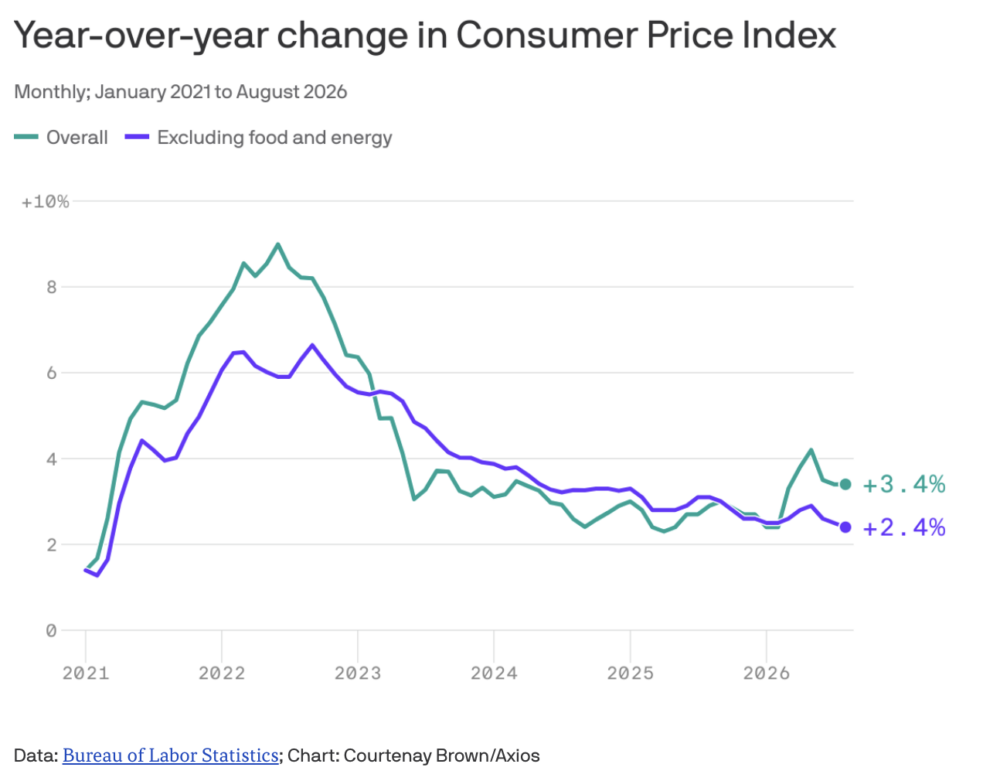
Consumer prices remained elevated in August as the Iran war’s energy shock fueled a fresh burst of inflation.
Why it matters: The renewed price pressures are squeezing household budgets, with signs that underlying inflation is proving stubborn across the broader economy.
- The data could strengthen the case for the Federal Reserve to raise interest rates next week.
By the numbers: The Consumer Price Index rose 0.4% in August from the previous month, after rising 0.1% in July, according to the Labor Department.
- Prices were up 3.4% from a year earlier, holding steady from July.
- Excluding volatile food and energy costs, the so-called core gauge climbed 0.3% during the month and 2.4% from a year earlier.
- That compares with increases of 0.2% and 2.5%, respectively, in July.
Between the lines: The inflation data carries
unusual weight ahead of the Fed meeting next week, when policymakers will be weighing the first interest rate hike in nearly three years.
- Fed governor Christopher Waller said last week that his decision would be “heavily influenced” by August inflation, noting that he would consider a rate hike if inflation came in hot.
- Some CPI components feed directly into the Fed’s preferred inflation gauge, the Personal Consumption Expenditures Price Index.
Zoom in: Energy drove much of the headline acceleration, but the underlying inflation picture was broader.
- Gasoline prices jumped 3.9% in August, accounting for more than a third of the overall monthly increase, the Bureau of Labor Statistics said. Energy prices rose 2.1%.
- But higher energy was not the entire story. Core inflation also accelerated, with shelter costs gaining 0.3% after a 0.1% increase in July. Airline fares rose 2.7%, while new and used vehicle prices also increased.
- There was some price relief last month, with medical care prices falling 0.2% and motor vehicle insurance dropping 0.8%. Grocery prices were unchanged.
The intrigue: The inflation outlook looks bleak from here, with energy prices so far shooting higher in September as the Iran war escalates.
- Oil prices are hovering around $100 a barrel, up from about $80 in mid-August.
- The average price of diesel hit a record $6 per gallon, AAA said on Friday.
What to watch: With less than two months
before the midterm elections, renewed inflation pressures could complicate the Trump administration’s effort to convince voters that affordability is improving.
The bottom line: The latest energy shock means that the economy — and policymakers — may have more inflation pressure to contend with in the months ahead.